
How Nigeria’s Deep Blue Project Can Anchor Gulf of Guinea Security

Three years ago, the Gulf of Guinea faced a maritime security crisis that threatened billions in trade, endangered seafarers, and destabilized the entire region. Pirates operating with near impunity attacked vessels throughout West African waters, holding crews for ransom and stealing cargo while coastal states lacked capacity to respond.
Today, that crisis has transformed dramatically. Piracy incidents in the Gulf of Guinea declined 90 percent from 2020 peaks. Nigerian territorial waters recorded zero piracy incidents for three consecutive years. The International Maritime Organization publicly commended Nigeria’s maritime security achievements.
This transformation offers lessons for West Africa’s maritime future and demonstrates why Nigeria should assume leadership in regional maritime cooperation.
The Crisis That Could Have Worsened
Between 2010 and 2020, maritime piracy in the Gulf of Guinea escalated from fewer than 40 annual incidents to 84 in 2020. Crews faced kidnapping, torture, and murder. Shipping companies paid millions in insurance premiums and ransom payments. The crisis threatened the region’s entire maritime economy and the livelihoods of millions dependent on fishing, trade, and port employment.
The root causes were predictable, weak coastal state maritime capacity, limited navy resources, fragmented regional coordination, limited prosecutorial capacity when suspects were captured, and underlying economic desperation in coastal communities where piracy offered income superior to legal maritime employment.
The Yaoundé Code of Conduct (2013) established a regional framework for maritime cooperation. It created information-sharing centers, coordination mechanisms, and joint exercises. These institutions were necessary but insufficient. Regional coordination frameworks cannot substitute for national maritime security capability.
Nigeria’s Game-Changing Initiative
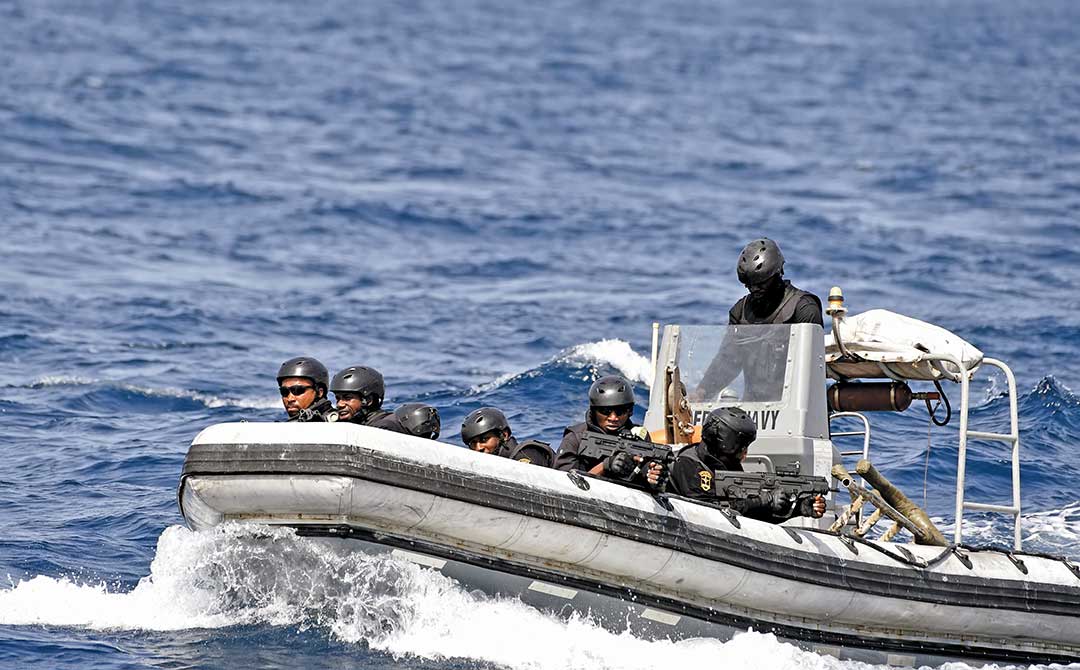
In June 2021, Nigeria launched the Deep Blue Project, a $195 million integrated maritime security operation combining air assets (helicopters, drones), sea assets (patrol vessels, interceptor boats), land assets (armored vehicles), and command-and-control infrastructure with 600 specialized personnel. The project created a C4i operational center providing real-time maritime domain awareness and rapid response capability across Nigerian waters.
The results were immediate and dramatic. Nigerian territorial waters went from experiencing piracy attacks to recording zero incidents for three consecutive years. Nigerian ports became safer. International shipping companies removed Nigeria from high-risk maritime zones.
Why did Nigeria succeed where regional frameworks struggled?
First: Political will. Nigeria’s government recognized maritime security as a national priority and committed sustained funding beyond international donor dependence. Three years of continuous operation required institutional commitment that regional frameworks, dependent on donor funding and political consensus, could not guarantee.
Second: Integrated command structure. The Deep Blue Project operated as a unified maritime security operation bringing together Navy, Coast Guard, Air Force, Army, and security agencies under common command. This integration solved inter-agency coordination problems that had prevented maritime security previously.
Third: Technology and training. Deep Blue invested in modern surveillance systems, rapid response platforms, and specialized personnel training. This capability provided persistent maritime awareness and rapid response capacity.
Fourth: Sustainable funding. Unlike regional centers dependent on international donor support that can evaporate with changing priorities, Deep Blue operates on government budget appropriations, ensuring operational continuity.
The Regional Leadership Opportunity
Nigeria’s success positions the nation to lead regional maritime security cooperation in ways the Yaoundé Code alone cannot achieve. This leadership involves:
First: Demonstrating that national maritime security capacity development is achievable and effective. Neighboring coastal states (Ghana, Togo, Benin, Cameroon) can study Nigeria’s Deep Blue model and develop comparable national capabilities. Successful national programs are more reliable than regional frameworks dependent on consensus and external funding.
Second: Bilateral maritime cooperation with neighboring states. Nigeria can share maritime domain awareness information with regional partners, coordinate patrol operations near shared maritime boundaries, and provide technical assistance for maritime center development. These bilateral relationships will be more stable than multilateral mechanisms.
Third: Supporting prosecutorial capacity. Even as piracy declined, prosecution rates remained near-zero, only three piracy cases adjudicated across the region in a decade despite hundreds of incidents. Nigeria can lead regional judicial reform, maritime court establishment, and evidence standards development to transform captured pirates into convicted criminals facing imprisonment rather than indefinite detention.
Fourth: Addressing root causes. Piracy recruitment thrives in coastal communities with high unemployment and limited economic opportunity. Nigeria should lead regional initiatives addressing youth unemployment, artisanal fishing community support, and alternative livelihood programs in vulnerable coastal zones. This prevents piracy resurgence when maritime enforcement attention decreases.
Fifth: International partnership leadership. Nigeria can coordinate with international naval partners especially U.S. to provide anti-piracy support. Rather than these operations occurring independently, Nigerian leadership could ensure they support rather than substitute for regional maritime security development.
Realistic Challenges
Nigeria’s maritime security success is genuine, but challenges remain:
Deep Blue’s operational pace is intense, and three years of continuous operations stress specialized personnel. Burnout and retention could become problems. Succession planning and personnel rotation are essential for sustainability.
Pirate networks remain structurally intact, with imprisoned leaders but functioning operational networks. If Deep Blue operations decreased, piracy could rapidly resurge. Sustainability requires permanent institutional commitment, not temporary high-intensity operations.
International naval presence contributed substantially to piracy reduction. If international patrols decrease, regional reliance on national capacity increases. Nigeria must ensure Deep Blue remains capable of independent operation.
Corruption of maritime security personnel and state security force collusion with criminal networks remain documented problems in the region. Governance reform and anti-corruption enforcement must parallel maritime security capability development.
The Path Forward
Nigeria’s maritime security success offers a model for West African maritime development that succeeds where regional frameworks alone could not. This model emphasizes national capacity development, political commitment, integrated command structures, and sustainable funding.
Nigeria should consolidate Deep Blue operations through legislative frameworks ensuring long-term funding and institutional continuity beyond political administrations. Nigeria should share lessons learned with regional partners through training programs and technical assistance. Nigeria should lead regional initiatives addressing prosecution, coastal community development, and governance reform.
The Gulf of Guinea’s maritime future depends not only on the Yaoundé Code and regional institutions, but on individual states developing world-class maritime security capacity and coordinating these capabilities through bilateral and multilateral mechanisms. Nigeria has demonstrated this is achievable.
The question now is whether Nigeria will sustain this commitment, share this model regionally, and anchor a maritime security structure that protects West African waters, seafarers, trade, and coastal communities for decades to come.