
Long-Range Strike and the Strategic Logic Behind the B-21 and H-20

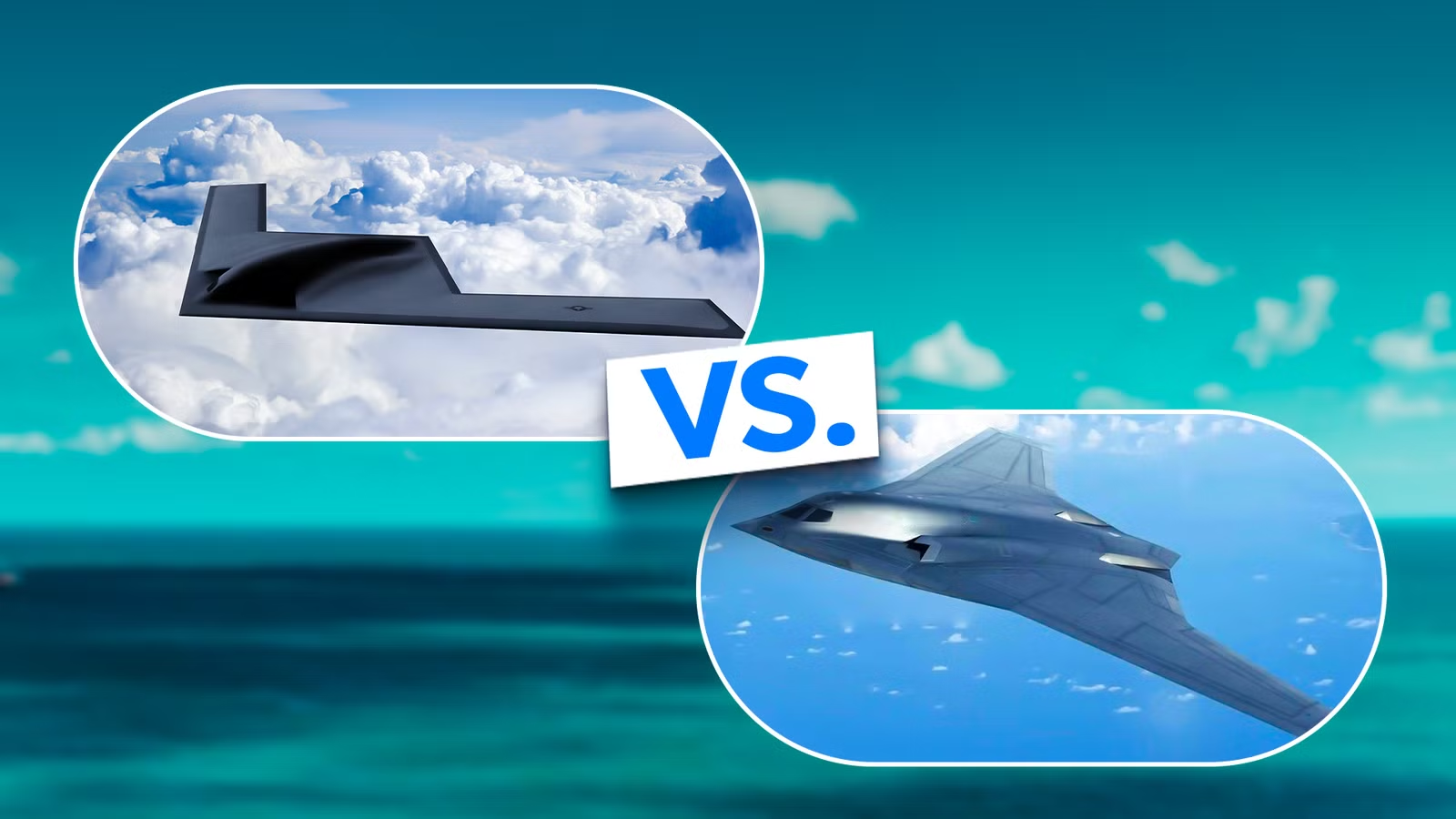
Strategic bombers rarely dominate headlines the way hypersonic missiles or aircraft carriers do, yet their quiet return to the center of force planning reveals something important about the direction of great-power competition. The development of the U.S. B-21 Raider and China’s anticipated H-20 bomber reflects a shared recognition that survivable, flexible long-range strike remains central to deterrence in a contested era.
During the Cold War, bombers were valued not only for their destructive potential but for their political utility. They could be dispersed, surged, recalled, or flown near contested regions as visible signals of resolve. Unlike ballistic missiles, they created decision space. In the decades after the Cold War, however, American airpower operated largely in permissive environments, and the strategic bomber appeared less urgent. The B-21 program signals a return to a different set of assumptions. It reflects preparation for conflict against peer competitors equipped with layered air defenses, long-range precision strike systems, and sophisticated surveillance networks.
The B-21 is designed to penetrate advanced anti-access and area denial systems while remaining adaptable to evolving technologies. Its significance lies not simply in stealth or range, but in survivability and scalability. In a potential Indo-Pacific contingency, the ability to conduct long-range strikes without relying exclusively on vulnerable forward bases complicates an adversary’s operational planning. A survivable bomber force strengthens deterrence by denial while also preserving credible options for deterrence by punishment.
China’s H-20 program, though less transparent, points toward a similar strategic evolution. For decades, Chinese airpower focused on regional defense and denying access within the first island chain. A true intercontinental stealth bomber would represent a shift toward extended reach and potentially a more diversified nuclear posture. Even without full clarity on the aircraft’s capabilities, the decision to pursue it carries strategic meaning. It suggests that Beijing views long-range airpower as necessary for global influence and as a complement to its expanding missile and naval forces.
The deeper issue is not which platform is superior, but what their parallel development reveals about the character of competition. Both Washington and Beijing appear to accept that future conflicts will be fought under conditions of contested access, degraded communications, and compressed decision timelines. In such an environment, platforms that combine reach, survivability, and signaling flexibility gain renewed importance. Bombers provide policymakers with options that are visible yet controllable, offering calibrated responses short of immediate escalation.
For the United States, the strategic question is not simply modernization, but scale and integration. A small fleet may signal commitment but lack operational resilience. A credible and sustainable force, integrated with allied basing, intelligence networks, and long-range strike doctrine, reinforces deterrence across theaters.
The renewed emphasis on long-range stealth bombers reflects more than technological competition. It reflects an understanding that deterrence in the twenty-first century will depend on flexible instruments of power that can operate inside contested systems without triggering automatic escalation. In that sense, the B-21 and the H-20 are less about nostalgia for Cold War triads and more about adapting enduring strategic logic to a new era of rivalry.