
The Overlooked Atlantic: Securing the Gulf of Guinea Before It Becomes the Next Global Chokepoint

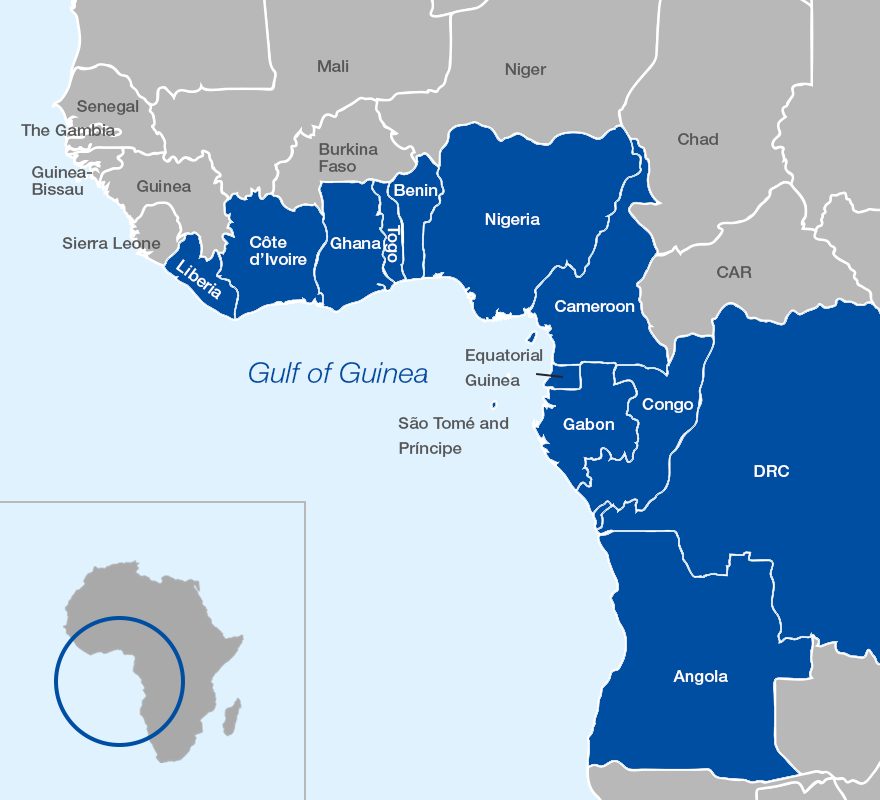
When the next supply-chain shock hits American factories, it may not originate in the Taiwan Strait or the Suez Canal. Imagine instead a tugboat quietly seized off Lagos, a handful of containers at Tema diverted with immaculate paperwork, and a rapid repricing of risk by marine insurers. Within days, a battery plant in Ohio is short graphite intermediates, a food processor in New Jersey pays more for cocoa, and manufacturers from Houston to Detroit juggle idle lines. The spark is local; the consequences are national. Treat the Gulf of Guinea as the Atlantic test bed for supply-chain defense, linking minerals, maritime law enforcement, and illicit-finance deterrence into a model Washington can replicate elsewhere.
This Atlantic arc already moves petroleum, cocoa, bauxite, manganese, and cobalt intermediates that underpin the energy transition. Demand curves are steepening: the International Energy Agency reported lithium demand up about 30% in 2023, and projects by 2040 a 50% rise in copper, a near-doubling in nickel, cobalt, and rare earths, and a roughly fourfold increase in graphite as electrification scales. Those trends expose U.S. factories to governance and security risk along African logistics corridors, making West Africa a first-order economic and strategic concern.
Headline piracy has fallen from its 2021 peak. The International Maritime Bureau recorded 116 incidents worldwide in 2024, then a 35% jump in Q1 2025, proof the Gulf of Guinea’s progress can quickly reverse if focus and funding slip.
Great-power competition is present but not the point. As Wagner receded, Moscow re-badged its footprint into the Africa Corps, signaling intent to remain a security broker in the Sahel and littoral. The prudent U.S. response is not a heavier military posture; it is to help partners build rules, capacity, and transparency at sea and in ports.
The answer is a narrow, law-enforcement-first campaign that hardens ports, cleans up logistics and information sharing. Call it Atlantic Shield.
Three actions for Atlantic Shield
- Give the region a U.S. Coast Guard spine: Institutionalize a yearly rotation, two medium-endurance cutters and mobile training teams, embedded in Obangame Express, combining presence, training, and rule-of-law.
- At sea: safe boarding, evidence collection, and chain-of-custody standards.
- Ashore: prosecutor and judicial clinics so arrests mature into convictions.
- Timeline: six-month pilot in FY2026, annual by FY2027.
- Cost: modest, leveraging planned deployments and existing security-cooperation funds.
- Payoff: deterrence grounded in court outcomes, not just boardings.
- Launch a Minerals & Ports Resilience Compact: Partner with Ghana, Côte d’Ivoire, Nigeria, and others to co-fund scanners, non-intrusive inspections, and port-community systems that digitize manifests and cut dwell time at key export hubs. Use DFC/EXIM financing with small grants, tied to transparency (EITI-aligned reporting, third-party audits) and pre-shipment checks for high-risk cargo.
- Timeline: two pilot ports in 12 months; five by year three.
- Costs: mostly loans; U.S. limited to guarantees and tech help.
- Payoff: faster, cleaner logistics, lower premiums, less smuggling, steadier U.S. inputs.
- Wire the Yaoundé Architecture for real-time enforcement: Add AIS feeds, anomaly analytics, and shared case files to YARIS so evidence moves cleanly from deck plate to courtroom; stand up joint legal cells to align charges across zones; use targeted sanctions and insurer discounts for “compliant ports”; and make IUU fishing a core mission under the FAO PSMA, since its profits often bankroll piracy.
- Costs: modest, software, connectivity, trainers; sanctions authorities already exist.
- Payoff: reduce impunity, money and market access, rather than chasing symptoms.
Why Now? and Why Not the Alternative?
Acting while incident rates are relatively low is cheaper and more durable than scrambling after a spike. Atlantic Shield operationalizes existing U.S. pledges to help African partners develop critical-mineral supply chains transparently and resiliently.
Why not just rely on allies, European programs, especially EU-funded support to the Yaoundé Architecture are indispensable, but over-reliance on a single partner is politically sensitive and leaves gaps the U.S. Coast Guard is uniquely suited to fill. Atlantic Shield broadens the coalition and centers regional leadership rather than substituting for it.
Cost–benefit
A lean package costs in the low tens of millions annually in U.S. funds and catalyzes hundreds of millions in blended finance for scanners and digitization. The avoided losses from even a short disruption, hundreds of thousands of tons of delayed bulk and containerized cargo across Lagos, Tema, and Abidjan would plausibly run into the billions across U.S. food and manufacturing supply chains once premiums and delays compound. The prudential math is straightforward.
Guardrails To Prevent Mission Creep
Tie funding to public, outcome-based metrics:
- Justice outcomes: Arrest-to-conviction rates in piracy, smuggling, and fisheries cases supported by U.S. training.
- Port performance: Average dwell time and on-time departures at participating ports.
- Market incentives: Number of vessels calling at “compliant ports” and the associated insurance premium differential.
- Evidence integrity: Share of interdictions logged through YARIS with complete, admissible evidence packets.
A Precise Call to Action
Congress (authorize a 3-year pilot):
- Direct DHS/USCG to begin a rotation in FY2026 aligned with Obangame Express.
- Fund State/DoD legal-interoperability teams and YARIS/operations-center upgrades.
- Empower DFC/EXIM to launch two Minerals & Ports pilots within 12 months.
Treasury (within 180 days):
- Issue a maritime illicit-finance advisory.
- Publish a “compliant ports” framework with insurer input.
State (by spring 2026):
- Conclude port-security MOUs with at least three coastal partners.
- Stand up a public dashboard tracking dwell time, prosecutions, and insurer participation.
Signal the stakes: Pair Atlantic Shield with Defense Production Act/DFC authorities to underscore that this is supply-chain insurance for the U.S. defense and clean-energy industrial base.
In conclusion, either we write the rules with our partners, or read the rules Beijing and Moscow write for us. A lean investment now protects U.S. workers and the industrial base from billion-dollar shocks later. Atlantic Shield is the small hinge that swings a heavy door.